// Practical guide
5 Ways to Start Using AgentPM Today
Five practical ways to turn coding-agent activity into visibility, evidence, follow-up work, safer operations, and continuity across agents.
Share


AgentPM provides a broad set of capabilities for engineering leaders, security and business operations teams, and individual developers looking to deploy coding agents safely and efficiently.
You do not need to redesign your workflow to begin. Connect the agents you already use, let AgentPM capture the work, and start asking better questions of the shared history. Here are five useful places to start.
01 / visibility
Understand organizational posture, velocity, and utilization
AgentPM gives you a complete history of your coding agents' work. User requests, model responses, tool calls, Git actions, and related events are captured inside AgentPM.
The web UI turns that history into a searchable notebook and organization-level views across agents, models, users, projects, and applications. Leaders can see adoption and utilization without reducing the work to a single token counter.
The CLI makes the same history available for deeper analysis. Group usage by project, owner, machine, model, agent, or session, then narrow the time window to answer specific operational questions.
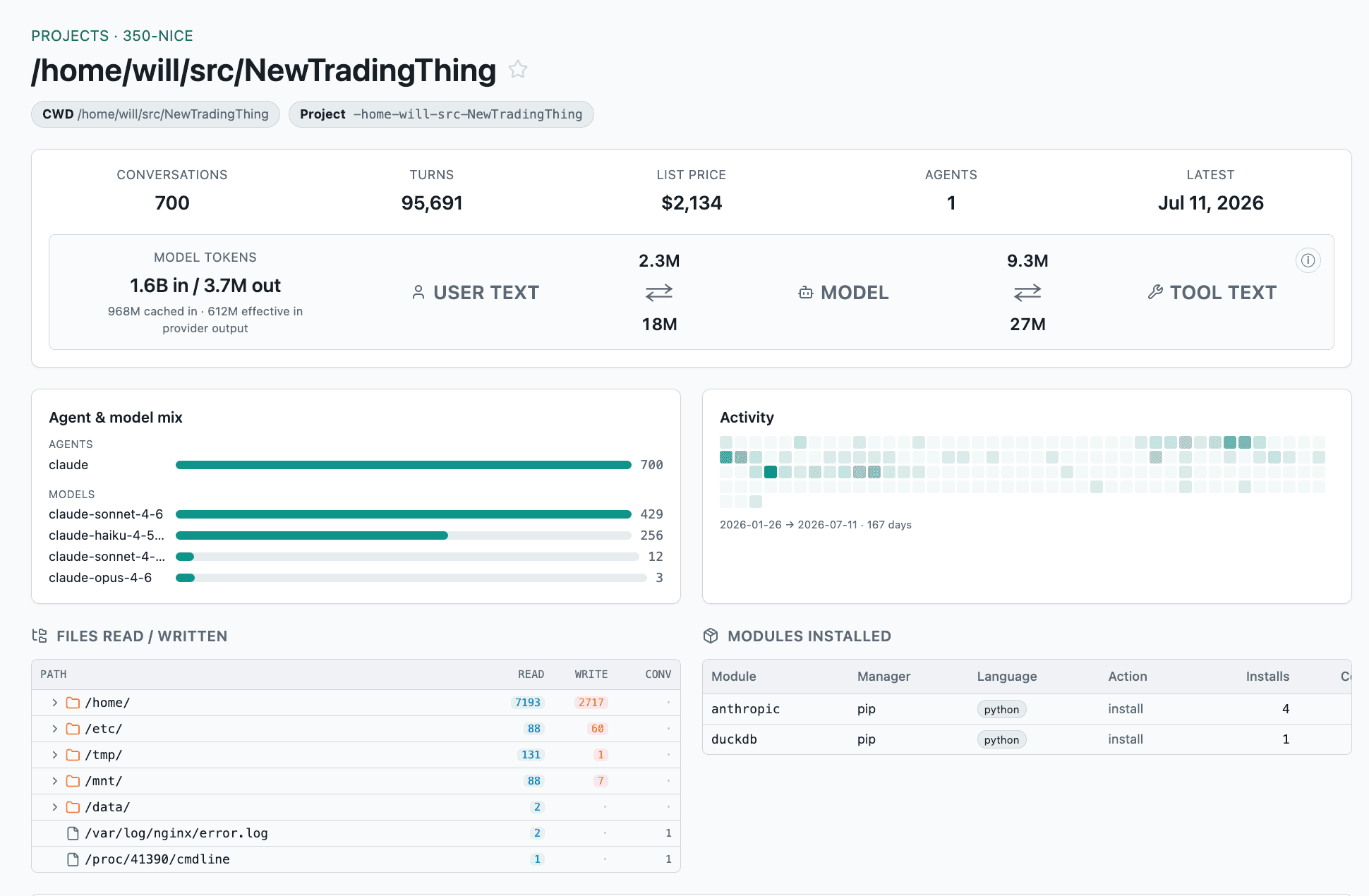
Screenshot 01Project activity and utilization
A project-level view of 700 conversations, 95,691 turns, model mix, activity, files touched, and installed modules.
$ agentpm usage weekly --group project --since 2026-07-01
Usage weekly · org engineering · America/Los_Angeles

PROJECT                    CONVS       TOKENS       COST
trading-platform              42         1.1B    $412.28
field-operations              31         742M    $286.09
agent-infrastructure          27         508M    $221.37
experiments                   15         171M     $68.18

TOTAL                        115         2.5B    $987.92

$ agentpm usage weekly --group agent --json > weekly-agent-usage.json
✓ exported 5 agent rollups for deeper analysis
- See where agent work is happening across the organization.
- Compare activity by project, agent, model, owner, machine, or session.
02 / investigation
Find the turn that mattered
When you retrace the steps behind an outcome, the answer is rarely limited to what eventually appeared in GitHub. It also lives in the settings, failed attempts, tradeoffs, and workflow choices made along the way.
AgentPM gives you a complete, searchable history of what happened. Facets and filters narrow the corpus; the notebook then takes you back to the exact source turn where a decision was made, a direction changed, or a problem began.
You can also start from a Git artifact. A trajectory query connects a pull request or commit to the conversation that created it and the later conversations that revised it.
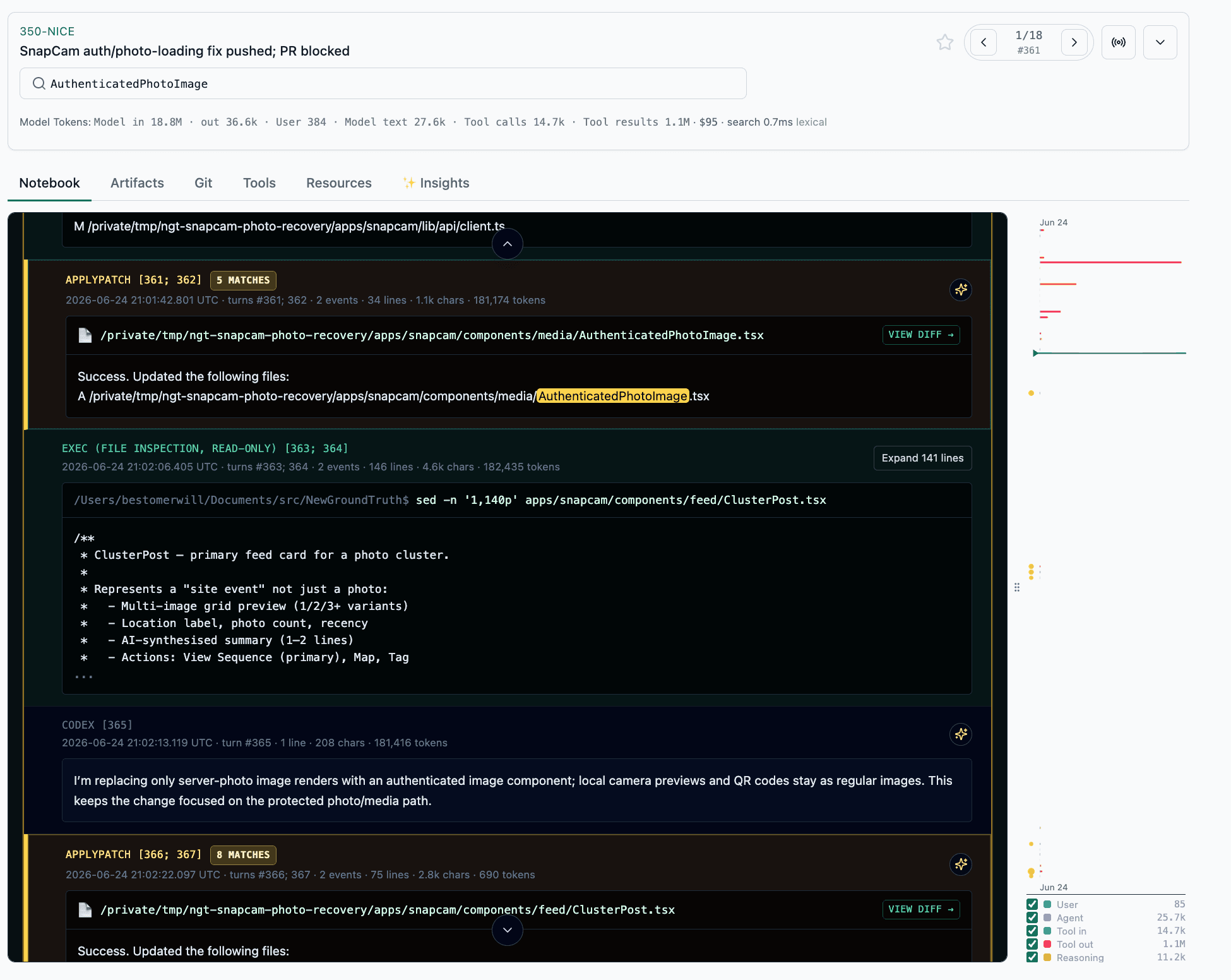
Screenshot 02Search inside the full notebook
A notebook search for AuthenticatedPhotoImage lands on the exact ApplyPatch event, with the surrounding tool activity and timeline still visible.
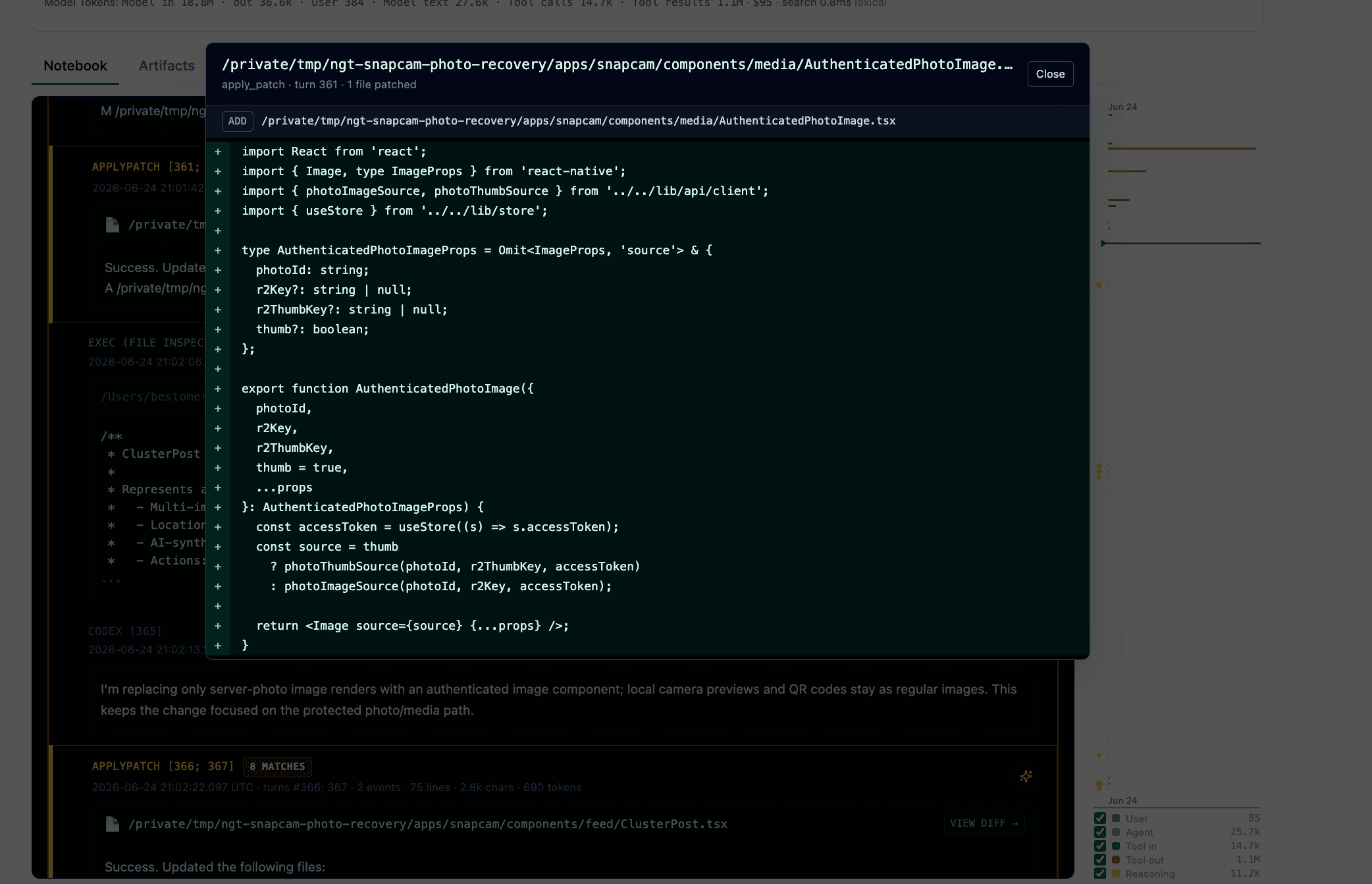
Screenshot 03Inspect the exact code change
The source-linked diff opens directly from the matching notebook event, showing the file and patch that changed the behavior.
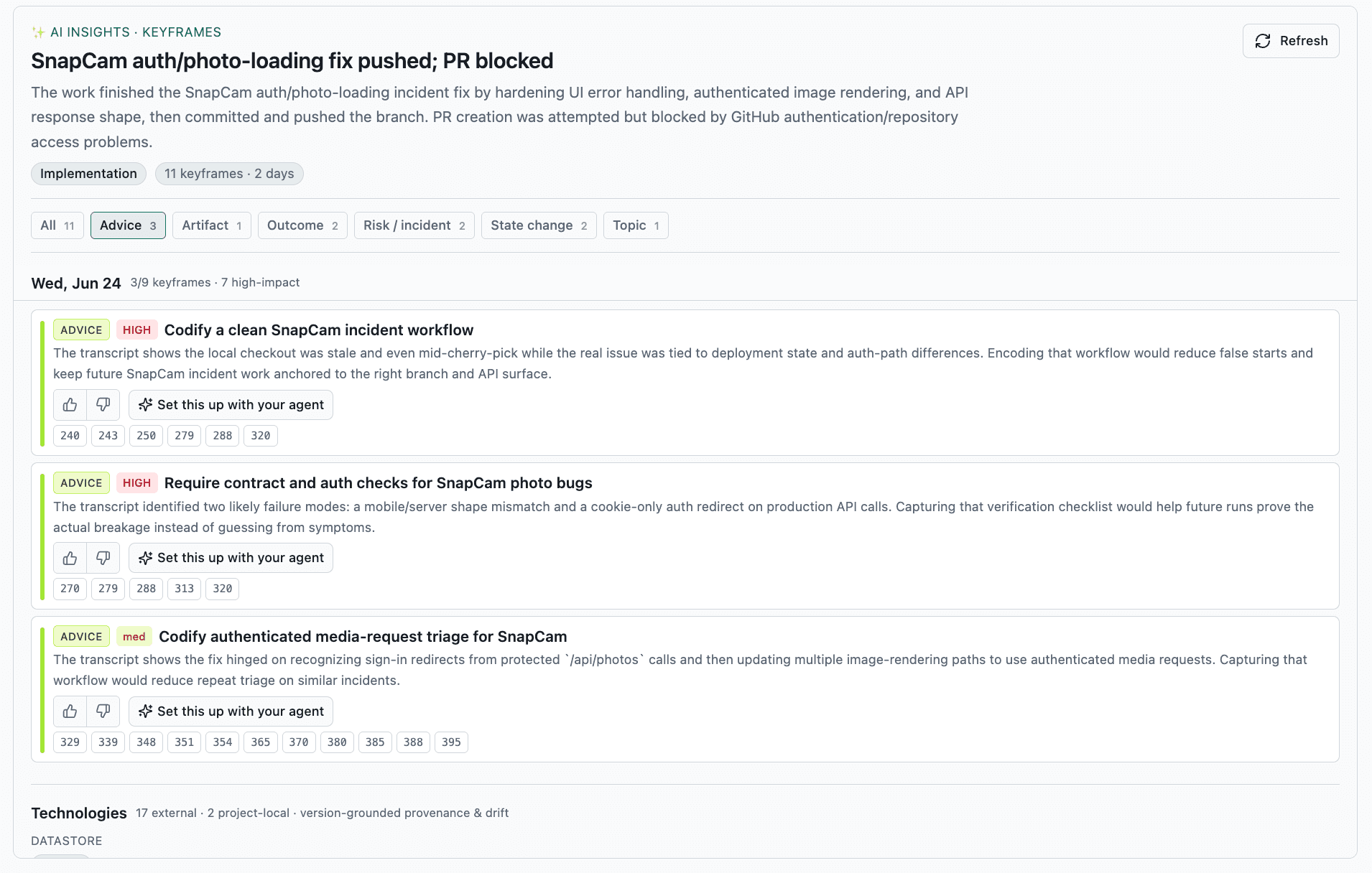
Screenshot 03BTurn the session into reusable insight
The same conversation is distilled into source-linked advice, risks, outcomes, and follow-up guidance without losing the original turns.
$ agentpm conv trajectory --pr 73 --limit 4
trajectory evidence for "PR 73"

ORIGIN
goc_3bda020...  Refresh public homepage for UAT
  turn 1394  gh pr create ... --title "Refresh public homepage for UAT"

FOLLOW-ON WORK
  turn 1433  slowed the hero rotation to 12 seconds
  turn 1495  replaced the handoff visual
  turn 1609  revised the human evidence copy

inspect: agentpm conv show --around 1394 --limit 60 goc_3bda020...
- Start from a result, PR, commit, file, tool, or phrase.
- Jump back to the exact source turn instead of reconstructing the story from a diff.
03 / follow-up
Find unfinished work
Agent work moves fast. Warnings go unaddressed, follow-up tasks are deferred, and important work can remain unfinished while everyone focuses on shipping the code in front of them.
AgentPM lets you review conversations later for work that was omitted, blocked, deferred, or explicitly flagged for follow-up. The result is not a generic task list: every item remains connected to the conversation and evidence that explains it.
Once identified, another agent can continue the work. You can also turn it into an issue in your tracking system, converting a temporary remark into durable work the organization can return to.
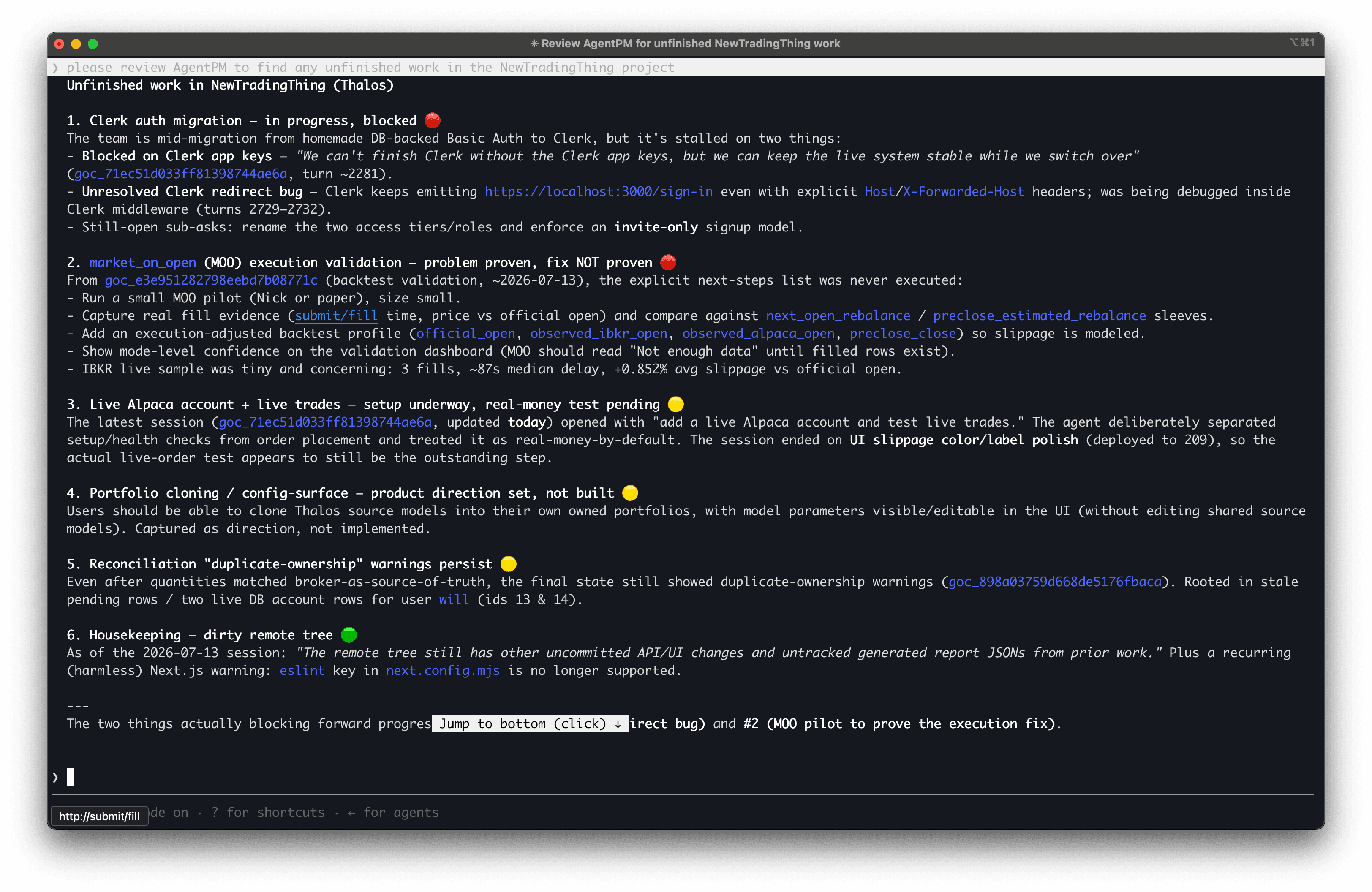
Screenshot 04Ask an agent to find unfinished work
A coding agent reviews the shared history and returns blocked, unproven, pending, and unresolved work with the source conversations needed to continue it.
$ agentpm conv work --cwd ~/src/trading-platform
3 open threads found across recent sessions

BLOCKED   Identity migration
          Waiting on application keys; redirect bug still unverified
          source: goc_71ec51... turns 6941-6998

VERIFY    Market-open execution
          Pilot run and fill evidence were not completed
          source: goc_898a037... turns 812-849

PENDING   Live account rollout
          Read-only health passed; real-order test remains
          source: goc_188a315... turns 2074-2092

$ agentpm conv show --around 2074 --limit 32 goc_188a315...
✓ opened the original handoff with constraints and next checks- Recover deferred work after the session has ended.
- Carry the original constraints and evidence into the next action.
04 / security
Locate security issues
Security issues can live inside the code, but in the agent world they can also live inside the conversation. A secret may be pasted into a prompt, a sensitive host may be accessed, a risky command may run, or an agent may notice a concern that never becomes a ticket.
AgentPM helps teams surface those situations, investigate what happened, and respond with the appropriate level of care. Tool facets make it possible to isolate mutating or privileged operations, while source-linked turns preserve the surrounding intent and result.
The same queries can become recurring reviews, so teams can monitor patterns instead of treating each event as an isolated incident.
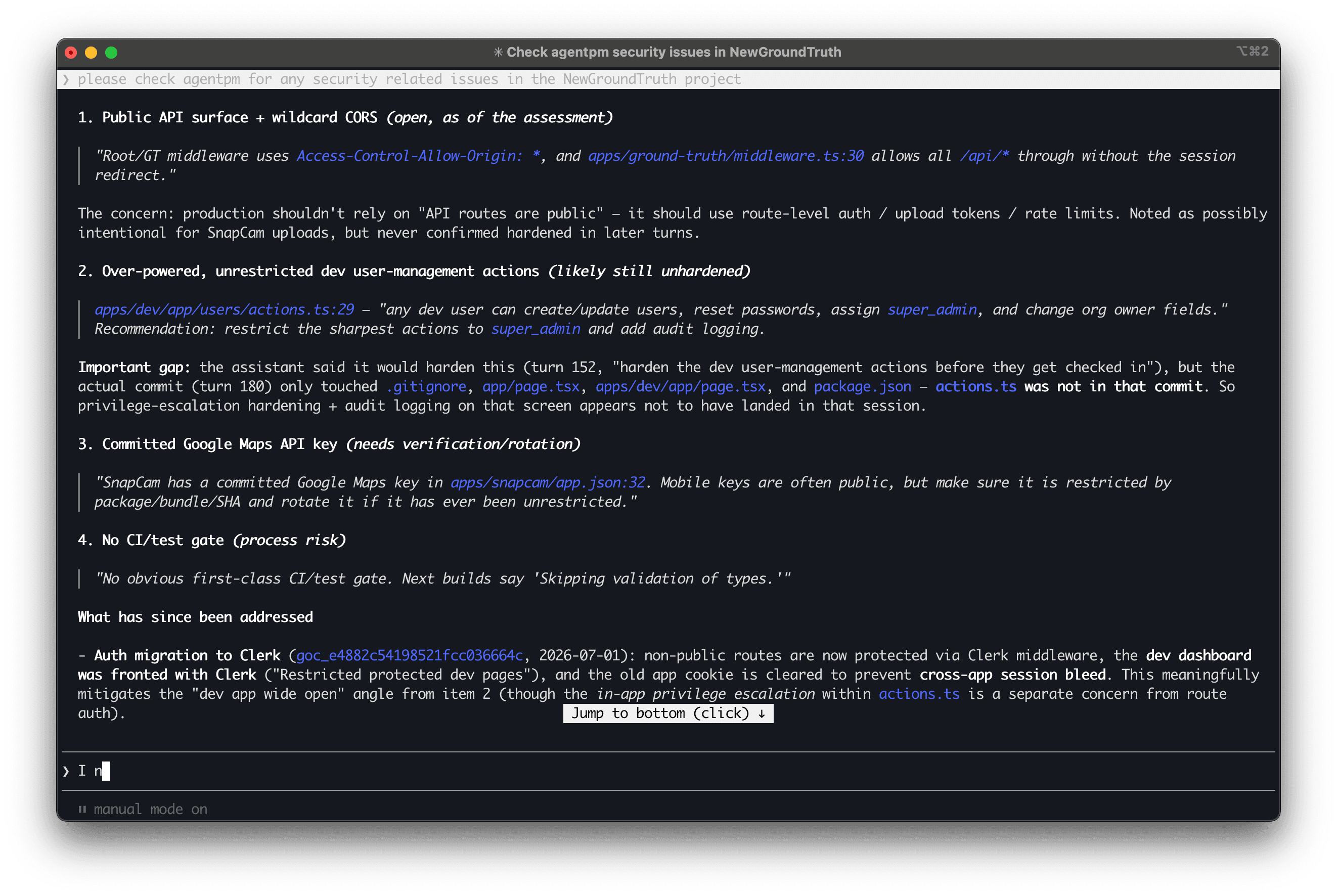
Screenshot 05Review security posture from the work history
A coding agent reviews source-linked concerns, distinguishes remediated controls from open work, and checks whether promised hardening appeared in the resulting changes.
$ agentpm conv search 'project:<project> security' --limit 5
12 relevant conversation(s)

  goc_a91f2c...  Review application security concerns
  goc_94bd01...  Restrict protected administrative pages
  goc_c3804e...  Authentication follow-up

$ agentpm conv find goc_a91f2c... 'harden before check-in'
2 source turn(s)

$ agentpm conv show --around 152 --limit 42 goc_a91f2c...
[152] assistant  harden administrative actions before check-in
[180] git        commit touched pages and package configuration

finding: the sensitive action file was not included in the commit
open: privilege checks and audit logging
resolved: route protection
review: restrict or rotate the client key
- Compare stated remediation with the files and commits that actually changed.
- Separate resolved controls from security work that remains open.
05 / continuity
Continue work from another agent
One of the most useful parts of AgentPM for developers is access to the full history across agents, machines, and projects.
When an issue resurfaces, a coding agent with the AgentPM skill can pull forward what was learned previously: what was attempted, what failed, which constraints mattered, what was verified, and what still needs to happen.
Completed code shows where the work ended. It does not always preserve why decisions were made or which investigation should not be repeated. AgentPM preserves that continuity and makes it usable in the next session.
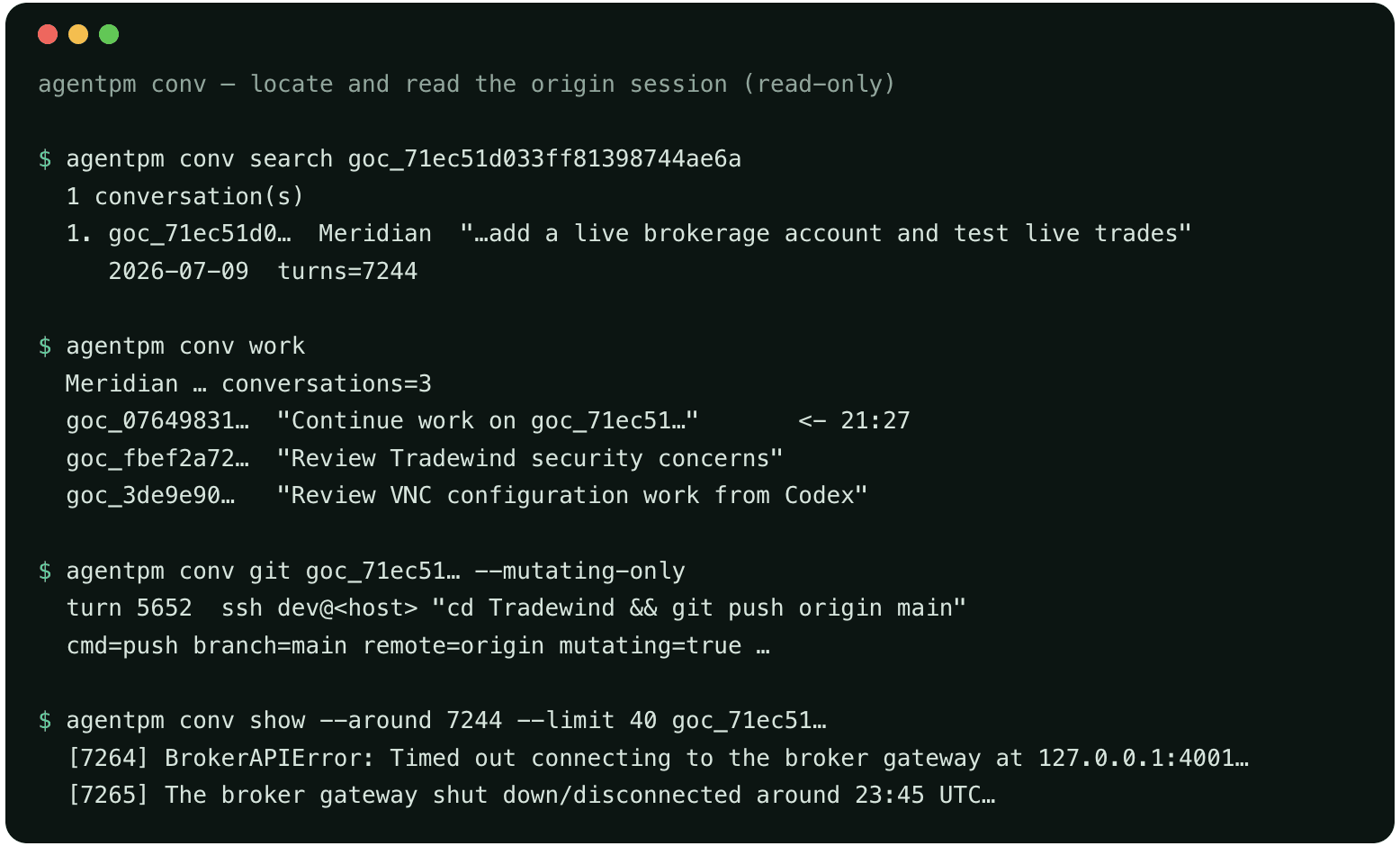
Screenshot 07A source-linked agent handoff
Capture a coding-agent session after the AgentPM skill retrieves prior conversations. Show the user's request, retrieved known state, watch-outs, open work, and source citations before the agent edits code.
user> Continue the broker halt work. Check AgentPM first.

agent> I'll retrieve the prior project state before changing code.

$ agentpm conv work --cwd ~/src/trading-platform
$ agentpm conv find goc_898a037... 'broker halt remaining next'
✓ 4 related conversations
✓ 1 shipped commit
✓ 2 verification checks

KNOWN STATE
  halt implemented and pushed
  broker-unavailable state blocks trading
  host-local API health verified

OPEN WORK
  check Alpaca authentication
  review PM2 logs before enabling orders

agent> I will continue from this state instead of reopening the investigation.
- Give the next agent a brief grounded in prior sessions, not a human-written recap.
- Continue from verified state while preserving source links for review.
From activity to knowledge
Build a shared history your organization can reuse
AgentPM turns coding-agent activity into searchable, reusable organizational context.
Whether you are measuring adoption, investigating a decision, recovering unfinished work, addressing a security concern, or handing a project from one agent to another, AgentPM preserves the evidence and context needed to move forward with confidence.
Start with the agents you already use.
Connect AgentPM, work normally, and use the shared history to understand what happened, recover what remains, and help the next human or agent continue.
The commands in this guide use the current AgentPM CLI syntax. Console output is representative, and identifying project, organization, machine, and repository names are obscured where appropriate.
Start capturing agent work